
Adaptive Thermal Comfort – Cardigans in July, T-Shirts in January
In summer, people wear cardigans at their desks because the air conditioning feels freezing. In winter, people are stripping off layer after layer to withstand the heat of the office. If they ask building management, both get the same answer: it’s 21°C, the same as it was in July and the same as it will be in March.
The problem isn’t the people. It’s the idea that there is one right temperature for the people in a building all year round.
Comfort was first measured in a lab
Thermal comfort science started in climate chambers. Around 1970, Ole Fanger described comfort as a heat balance between a person and their surroundings. His Predicted Mean Vote (PMV) model, which predicts the average comfort vote of a group of people, uses six factors:
- Air temperature
- Radiant temperature
- Air speed
- Humidity
- Clothing
- Metabolic rate (how active you are)
The first four are the environmental parameters and the last two are about the person. It’s a good model that explains broadly what affects people’s comfort. But when researchers took it out of the lab and into real offices, people often didn’t feel the way it predicted.
People adapt
That gap led to adaptive thermal comfort theory. Fergus Nicol and Michael Humphreys started asking people in real buildings how they felt, and comparing their answers with the weather outside. In 1998, Richard de Dear and Gail Brager brought together large datasets from buildings worldwide and found a clear pattern.
In naturally ventilated buildings, the temperature people found comfortable rose and fell with the outdoor temperature. They were happy across a much wider range than the lab model expected. In sealed, air-conditioned buildings, people were comfortable in a much narrower band.
The reason is that people adapt, in three ways:
- Behaviour: we put on a jumper (personal), open a window or turn on a fan (technical), have a siesta (cultural).
- Physiology: over generations our bodies adapt genetically, and day to day they react to temperature by changing blood flow to the skin.
- Psychology: we carry a thermal memory of environments we have experienced over days and years.
This is now part of the standards we work to: ASHRAE 55, CIBSE Guide A and TM52, and EN 16798. The comfort temperature rises by about a third of a degree for every degree the outdoor running mean temperature rises. The running mean weights the last few days most heavily, which is close to how our own thermal memory works.
We get used to what we’re given
The most interesting finding came more recently. In 2020, researchers at UC Berkeley and the University of Sydney reanalysed the adaptive model with over 60,000 measurements. When they compared people’s comfort with the indoor temperature they’d been exposed to, rather than the weather outside, the relationship was even stronger. And it held for air-conditioned buildings too.
In other words, people in air-conditioned offices do adapt. They adapt to both the external temperature and the fixed temperature we give them. Hold a building at 21°C all year and 21°C becomes what people expect. This is not surprising when you look at the amount of extra clothing brought into offices. The narrow comfort band in most offices is something we’ve partly created ourselves.
The researchers’ suggestion is simple: nudge setpoints gradually with the weather and the seasons, and let people adapt with them.
Why it saves energy
This isn’t only about comfort. Adaptive setpoints are one of the simplest ways to save energy in a building.
Where comfort moves with the seasons, setpoints can sit a little higher in summer and a little lower in winter. Meaning less cooling in the summer and less heating in the winter, and people stay comfortable because they’ve adapted to the weather and know what to expect from the building.
The savings are significant. A UK study found that applying adaptive setpoints in fully air-conditioned offices could save around 30% of cooling energy while keeping occupants comfortable. Studies in other countries show similar results:
- South Korea: 22%
- Japan: 29 to 52%
- India: 9 to 26%
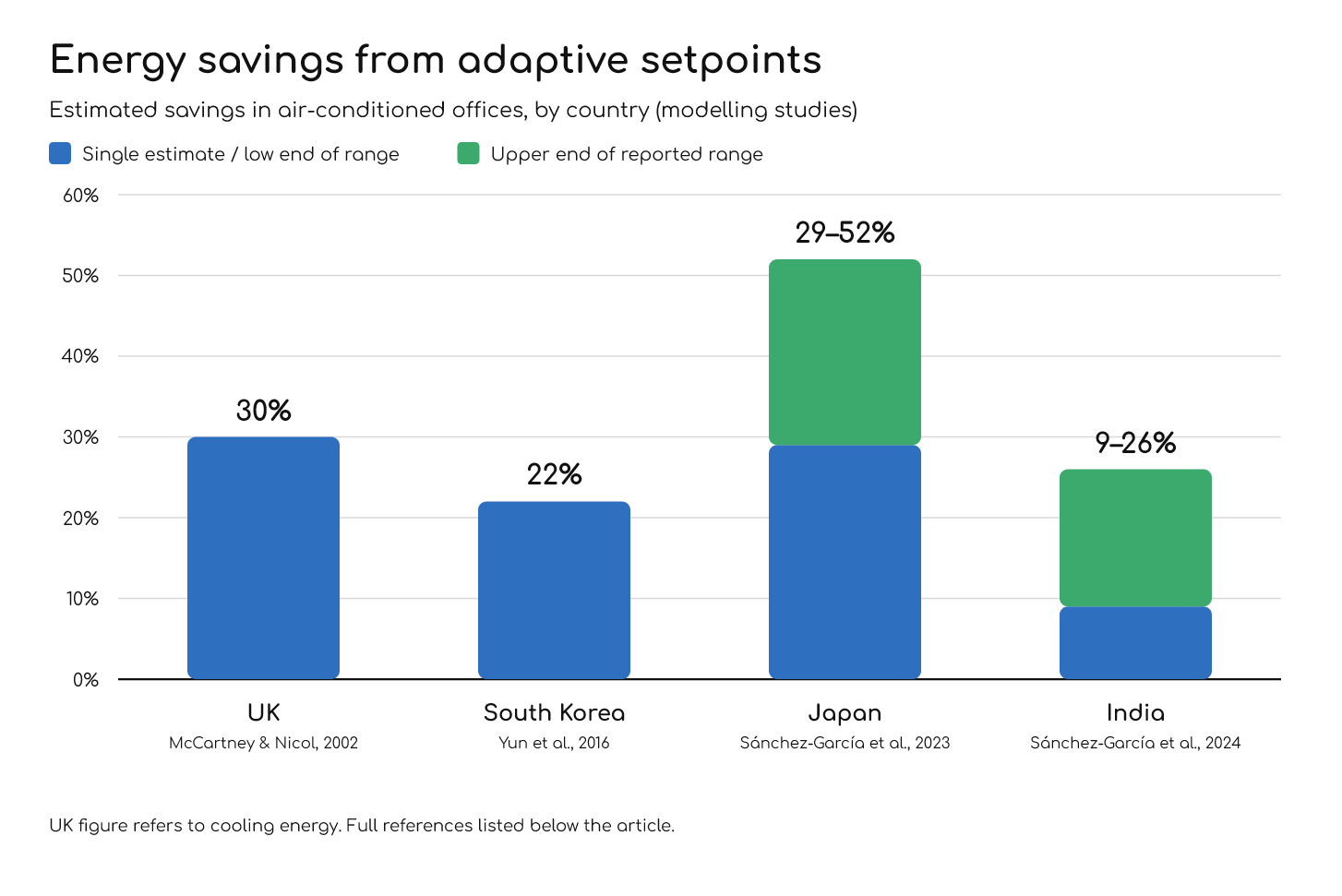
These studies are provided in a table at the end.
What we still need to learn
Most of these savings figures come from modelling. A field study in a mixed-mode building has shown excellent results, but we haven’t yet found a field study in a fully air-conditioned building. That’s a gap we are closing with our own research.
There are limits, too. Comfort temperatures don’t keep falling forever in cold weather: there’s a floor in part because of radiant temperature effects. And there’s an open question we’re working on ourselves: how quickly can you move a setpoint before people notice?
Seasons and people, together
At Klimatica, adaptive thermal comfort is built into how we control buildings. Setpoints follow the outdoor temperature, so the building moves with the seasons instead of holding one number all year. In our studies so far, that has reduced heating and cooling loads by between 18 and 28%.
21°C was never a law of nature. It was a habit. We think buildings can do better by following the weather, and the people inside.
#ThermalComfort #AdaptiveComfort #Sustainability #FacilityManagement
Posted on 09/11/2026 by Victoria Tink
References
- McCartney, K.J. and Nicol, J.F. (2002). Developing an adaptive control algorithm for Europe. Energy and Buildings, 34, 623-635.
- Yun, G.Y., Lee, J.H. and Steemers, K. (2016). Extending the applicability of the adaptive comfort model to the control of air-conditioning systems. Building and Environment, 105, 13-23.
- Sánchez-García, D., Bienvenido-Huertas, D., Pulido-Arcas, J.A. and Rubio-Bellido, C. (2023). Extending the use of adaptive thermal comfort to air-conditioning: the case study of a local Japanese comfort model in present and future scenarios. Energy and Buildings, 285, 112901. https://doi.org/10.1016/j.enbuild.2023.112901
- Sánchez-García, D., Huertas, J.D. and Rubio-Bellido, C. (2024). The energy saving potential of using adaptive setpoint temperatures: a case study for offices in India. DOI: 10.62744/CATE.45273.1115-172-180
- Aparicio-Ruiz, P., Barbadilla-Martín, E., Salmerón-Lissén, J.M. and Guadix-Martín, J. (2018). Building automation system with adaptive comfort in mixed mode buildings. Sustainable Cities and Society, 43, 77-85. https://doi.org/10.1016/j.scs.2018.07.028
- Barbadilla-Martín, E., Guadix Martín, J., Salmerón Lissén, J.M., Sánchez Ramos, J. and Álvarez Domínguez, S. (2018). Assessment of thermal comfort and energy savings in a field study on adaptive comfort with application for mixed mode offices. Energy and Buildings, 167, 281-289. https://doi.org/10.1016/j.enbuild.2018.02.033
- Sánchez-García, D., Rubio-Bellido, C., Martín del Río, J.J. and Pérez-Fargallo, A. (2019). Towards the quantification of energy demand and consumption through the adaptive comfort approach in mixed mode office buildings considering climate change. Energy and Buildings, 187, 173-185. https://doi.org/10.1016/j.enbuild.2019.02.002
Share This Story, Choose Your Platform!
Ready to see what Klimatica can do for you?
Give us a ring. Drop us an email. Book a meeting.